When collectible brands search for “custom scale model manufacturers,” they are rarely looking for a directory of names — they are looking for a shortlist of partners who can deliver quality, protect the brand, and scale. This guide reframes the search as a 10-trait checklist you can use to screen any factory, including ChilBo, before you commit volume. It is written from the buyer’s side so you can apply it to your own supplier search.
Table of Contents
- Quick Answer: How to Shortlist the Right Partner
- In-House Tooling and Mold Ownership
- Tolerance and Dimensional Control
- Material and Process Range
- Finish, Paint, and Print Capability
- Quality System and Inspection
- IP Protection and Confidentiality
- Scale-Up and Capacity
- Compliance and Export Readiness
- How ChilBo Measures Against the 10 Traits
1. Quick Answer: How to Shortlist the Right Partner
Shortlist a custom scale model manufacturer by checking ten traits: in-house tooling, tight tolerances, material range, finish capability, a real QC system, IP protection, scale-up capacity, export compliance, communication, and proven experience. The OEM factory vs trading company comparison explains why in-house tooling and direct control usually beat a broker for branded lines.
Use the list below as a scorecard. A factory that clears most of it is worth a sample run; one that can’t is a risk regardless of price.
2. In-House Tooling and Mold Ownership
In-house mold design and cutting is the single biggest quality lever. It lets the factory hold tolerance through the whole run, absorb revisions without re-quoting, and keep the tool under your ownership agreement. A factory that outsources tooling loses control of timing and consistency.
Confirm who owns the mold in writing and what happens to it if you move production. Clear ownership protects your investment and your IP.
3. Tolerance and Dimensional Control
For scale models, tolerances around ±0.02 mm on precision tooling are what keep parts fitting and proportions correct. Ask for the tolerance in writing and verify it on a sample with a caliper or gauge. Loose tolerance means gaps and misalignment that no paint hides.
Tolerance is a process outcome, not a promise. A factory with in-house tooling and in-line measurement is far more likely to hold it than one relying on external shops.
4. Material and Process Range
A strong partner works across ABS, PP, PC, and PVC and knows when each fits. The ability to mix materials — rigid structural parts plus flexible or soft-touch parts — lets one factory handle a whole product line instead of splitting it across vendors.
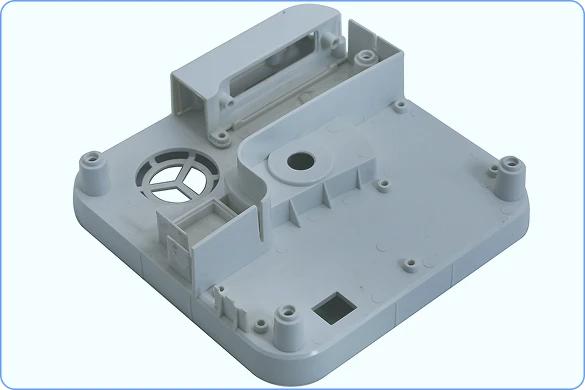
Material range also matters for cost and compliance: the right resin choice can cut cost or meet a chemical standard without redesign.
5. Finish, Paint, and Print Capability
Premium scale models need calibrated color (Pantone or RAL), consistent batches, and registered pad or tampo printing for marks and badges. Ask to see samples with fine print and layered finishes; that is where weaker factories fall short.
Print and paint consistency across a run is a process-control signal — if a factory can show matched units from different batches, that is strong proof of capability.
6. Quality System and Inspection
Look for first-article approval, in-line inspection, dimensional checks, and per-batch records. A factory that cannot show a per-batch inspection log is asking you to trust quality you cannot verify. The table below maps each checkpoint to what it protects.
| Checkpoint | Verifies | Protects |
|---|---|---|
| First-article approval | First parts vs approved sample | Catches setup error early |
| Dimensional check | Critical sizes vs tolerance | Fit and proportion |
| Color and print check | Batch vs standard | Consistency |
| Per-batch record | Inspection log | Traceability |
7. IP Protection and Confidentiality
For branded and licensed lines, IP protection is non-negotiable. Require a signed NDA, a clear mold-ownership clause, and limits on sample and file distribution. In-house, end-to-end production reduces the handoffs where leaks most often happen. MOQ and confidentiality often go together — our MOQ technical guide for collectible models covers how order size interacts with tooling and IP.
A factory that treats your files casually will treat your brand casually. Choose a partner whose process keeps your IP contained.
8. Scale-Up and Capacity
A good sample run means little if the factory cannot scale. Ask about monthly capacity, how they add shifts or cavities, and how they keep quality when volume jumps. Lean manufacturing and in-house tooling make scale-up smoother because nothing depends on an outside shop’s queue.
Also ask how revisions are handled at scale — in-house tooling lets a factory absorb a change without re-quoting or restarting the vendor search.
9. Compliance and Export Readiness
If you sell to North America or Europe, expect ASTM F963, CPSIA, and EN71 for toy-adjacent items, plus RoHS and REACH for materials and finishes. A partner experienced in export compliance saves you from blocked shipments and recalls. Confirm the exact requirements for your target markets before production.
Export readiness also includes documentation — test reports, material declarations, and inspection records that customs and retailers may request.
10. How ChilBo Measures Against the 10 Traits
ChilBo is a one-stop OEM/ODM custom plastic manufacturer with 20+ years of experience, in-house mold design and tooling, and export experience across 50+ countries. We run prototyping in about 5–10 days, hold tight tolerances on precision tooling, validate fit and color on a physical sample, and produce with in-line inspection and per-batch records. For the selection method behind a good partnership, see our guide on choosing a model kits manufacturer.
Because tooling, molding, finishing, assembly, and packaging all happen under one roof, ChilBo clears the 10 traits without the handoffs and quality risk of a broker.
Frequently Asked Questions
Should I use a factory or a trading company?
For a branded line, a factory with in-house tooling usually wins on control, cost, and IP safety. A trading company can aggregate volume but adds a handoff and a markup. See the OEM vs trading company comparison for the full trade-off.
What tolerance should I require for scale models?
Around ±0.02 mm on precision tooling is a strong benchmark for fit and proportion. Get it in writing and verify on a sample before a full run.
How do I check a factory’s quality without a big order?
Request a physical sample and review it against the 10 traits, especially per-batch records and print consistency. A confident factory will share samples and documentation.
What compliance do I need for export?
Toy-adjacent items typically need ASTM F963, CPSIA, and EN71 by market; general plastics often need RoHS and REACH. Confirm the exact set for your regions with the supplier.
Can ChilBo scale from prototype to volume?
Yes. ChilBo prototypes in about 5–10 days and scales on the same in-house tooling, keeping consistency from first unit to volume with in-line inspection and per-batch records.
Request a Quote
If you are shortlisting custom scale model manufacturers, share your design, target material, expected volume, and markets with our team. ChilBo will score your project against these 10 traits, prototype in about 5–10 days, and produce with in-line inspection and per-batch records. Contact our team with your project details and we will follow up with a recommendation and a quote.