Specifying the wrong plastic for an educational toy can turn a best-seller into a recall. In classrooms and daycare settings, toys are mouthed, dropped, and shared for hours every day — so material safety and durability are not marketing claims, they are engineering requirements. This guide compares ABS and PVC specifically for educational and learning toys, so procurement and product teams can choose with evidence rather than assumption.
The comparison matters because the two materials behave differently under stress, carry different compliance burdens, and send different signals to institutional buyers. We will look at real mechanical data, regulatory limits, and classroom failure modes, then give a decision framework you can use in your next product specification.
Table of Contents
- Why Material Choice Matters More for Educational Toys
- ABS vs PVC: What Each Material Actually Is
- Mechanical Properties in Plain Numbers
- Safety Profile: Phthalates, BPA, and Mouthing Risk
- Durability and Classroom Performance
- Manufacturing and Cost Considerations
- Comparison Table: ABS vs PVC for Learning Toys
- Common Buyer Mistakes
- Decision Framework and Recommendation
1. Why Material Choice Matters More for Educational Toys
Educational toys see heavier, group-based use than home novelties. A block chewed by a toddler or a manipulative dropped on a tile floor must not crack, leak plasticizer, or develop a sharp edge. In 2024, regulators recalled more than 700 toy batches across the EU, U.S., Canada, and Australia. The leading causes were choking hazards and chemical violations — especially phthalates and lead. Material selection is the first line of defense against both.
Conclusion: For hard, interlocking learning toys, ABS is the safer and more durable default; PVC is viable only for specific soft components and only with verified phthalate-free certification. This material decision is one part of a larger manufacturing picture — see the complete educational toy manufacturing guide for the full pathway. For engineering tolerances, see STEAM toy design for manufacturing.
2. ABS vs PVC: What Each Material Actually Is
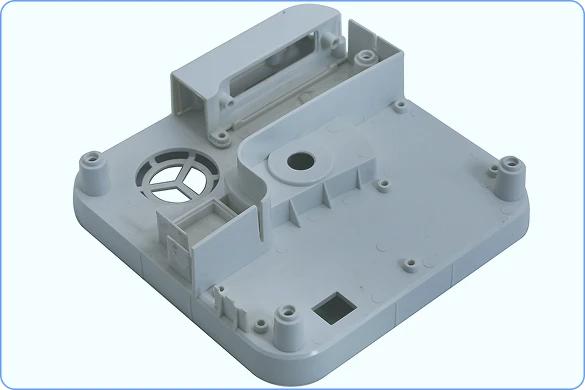
ABS (acrylonitrile butadiene styrene) is an amorphous engineering thermoplastic made from three monomers. Acrylonitrile contributes heat and chemical resistance, butadiene adds toughness and impact strength, and styrene provides rigidity and surface gloss. It needs no plasticizers to achieve its properties, which is why it is the material behind precision building bricks and electronic housings.
PVC (polyvinyl chloride) is a chlorine-containing thermoplastic. Rigid PVC is naturally brittle and is used mainly in construction and piping. Soft PVC — the kind used in flexible toy parts — requires added plasticizers to become pliable. Those plasticizers, particularly phthalates, are the source of most regulatory concern in children’s products.
Conclusion: ABS is inherently stable and additive-light, while PVC’s safety depends entirely on how its soft variants are formulated and certified. ChilBo uses virgin-grade ABS as the default for structural educational parts and reserves PVC for carefully specified soft components.
3. Mechanical Properties in Plain Numbers
The table below summarizes typical industry ranges for injection-molding grades of these materials. Exact values vary by grade, filler content, and supplier datasheet.
| Property | ABS | Rigid PVC | Soft PVC (plasticized) |
|---|---|---|---|
| Density (g/cm³) | 1.02–1.08 | 1.38–1.45 | 1.16–1.35 |
| Tensile strength (MPa) | 30–50 | 40–60 | 10–25 |
| Notched impact (kJ/m²) | 15–40 | 2–10 | 50+ |
| Heat deflection temperature | 93–118 °C | 65–90 °C | Varies |
| Shrinkage (%) | 0.4–0.9 | 0.2–0.8 | 0.6–1.5 |
| Relative resin cost | Higher | Lower | Lower |
ABS is lighter, tougher at low temperatures, and more dimensionally predictable. PVC is denser and can be stiffer in rigid form, but rigid PVC becomes brittle under impact. Soft PVC is flexible but introduces the plasticizer burden. For educational toys that are dropped, stacked, and mouthed, ABS usually wins on the combination of safety, durability, and weight.
4. Safety Profile: Phthalates, BPA, and Mouthing Risk
Young children mouth toys. Regulators restrict this directly: ASTM F963 and EN71 limit phthalates (DEHP, DBP, BBP, DINP, DIDP, DNOP) to ≤0.1% in accessible plasticized parts. CPSIA restricts total lead to ≤100 ppm in substrate and ≤90 ppm in coatings. EN71-3 sets migration limits for heavy metals.
ABS and PP are inherently phthalate-free and BPA-free when sourced from compliant resin. BPA is primarily a concern with polycarbonate, not with ABS. PVC’s safety depends on formulation. Soft PVC may contain phthalates unless explicitly certified phthalate-free. ChilBo requires third-party test reports for any PVC component and defaults to virgin ABS for parts children contact.
Conclusion: ABS and PP are inherently lower-risk for any part a child can mouth, whereas soft PVC requires explicit phthalate-free verification. Our educational toy safety compliance checklist covers how to verify these limits with third-party test reports.
5. Durability and Classroom Performance
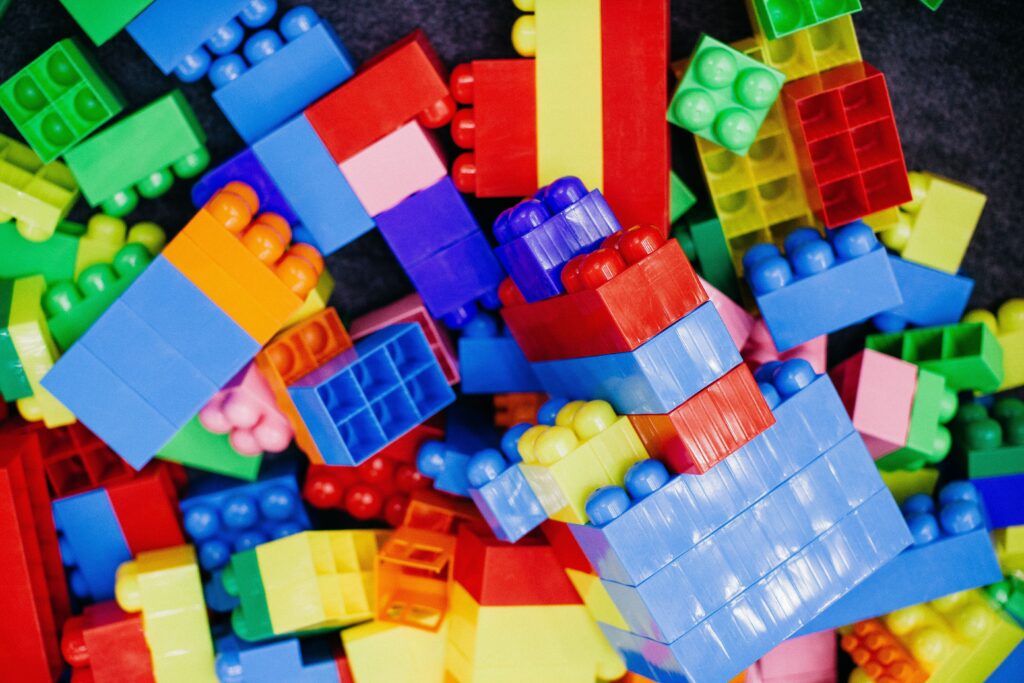
ABS offers high impact resistance and stable clutch power — bricks interlock tightly yet separate by hand, and color is locked into the polymer so it does not fade under classroom light. Its density of roughly 1.05 g/cm³ also keeps kits lighter for teachers and students. PVC, especially rigid PVC, is more brittle and prone to cracking on impact; soft PVC resists cracking but can develop surface tack or odor if formulation is poor, and it can harden over time as plasticizers migrate.
Conclusion: For parts that must survive years of dropping, stacking, and washing, ABS delivers the longest functional life; PVC is best limited to soft, non-load-bearing components.
6. Manufacturing and Cost Considerations
ABS typically costs more per kilogram than commodity PVC, but its processing is predictable: low shrinkage variation, stable dimensions, and fewer post-mold defects. PVC’s chlorine content demands careful thermal control during molding and can accelerate mold corrosion if not managed. In 2023, global PVC prices hovered near USD 760 per metric ton, while ABS was near USD 1,280 per metric ton. However, the apparent material saving of PVC is often offset by tighter processing controls, higher scrap risk, and certification overhead.
Conclusion: Total cost of ownership — not resin price — should drive the decision. ABS usually wins for structural educational parts because it reduces compliance risk, processing risk, and field failure risk.
7. Comparison Table: ABS vs PVC for Learning Toys
| Factor | ABS | PVC (soft, plasticized) | Recommendation |
|---|---|---|---|
| Mouthing safety | Inherently phthalate/BPA-free | Needs phthalate-free certification | ABS for any mouthed part |
| Impact durability | High; resists dropping | Soft = flexible; rigid = brittle | ABS for structural parts |
| Dimensional stability | Excellent, low shrinkage variance | Variable; sensitive to formulation | ABS for interlocking fit |
| Colorfastness | Pigment locked in polymer | Can migrate or fade | ABS for repeated handling |
| Processing risk | Predictable molding | Corrosion & thermal control needed | ABS for cleaner production |
| Weight | Lighter (~1.05 g/cm³) | Heavier (~1.3 g/cm³) | ABS for large kits |
| Best use | Bricks, manipulatives, housings | Soft grips, flexible decorations | Match to function |
8. Common Buyer Mistakes
- Assuming “PVC” is uniformly unsafe — rigid vs plasticized matters, and certified phthalate-free PVC has valid uses.
- Choosing on resin price alone and ignoring certification and processing cost.
- Forgetting to request a material safety certificate and lab report per production batch.
- Using soft PVC for a load-bearing snap-fit, where brittleness or tackiness causes field failures.
- Not specifying virgin-grade resin, which raises contamination and compliance risk.
9. Decision Framework and Recommendation
Choose ABS when the part is rigid, interlocking, mouthed, or must keep its fit and color through years of classroom use.
Choose certified phthalate-free PVC (or TPE) when you need a soft, flexible, non-load-bearing component — and only with documented compliance and a third-party test report.
For most educational and learning toy programs, standardizing on virgin-grade ABS for structural parts is the lowest-risk path to durability and compliance. Explore how ChilBo applies this in production on our educational & learning toy manufacturing page.
Frequently Asked Questions
Is ABS plastic safe for toddlers?
Yes. ABS is rigid and does not require phthalates or BPA, so it is widely used in building blocks and learning toys. Always confirm the resin is from a certified, virgin-grade source.
Is PVC safe for educational toys?
Rigid PVC is brittle; soft PVC may contain phthalates. It is acceptable only for specific soft parts with explicit phthalate-free certification and a test report.
Which is more durable, ABS or PVC?
ABS is more durable for structural, dropped, and mouthed parts. Soft PVC resists cracking but can degrade in surface quality; rigid PVC cracks on impact.
Do I need a test report for both materials?
Yes for any market-bound toy. Request heavy-metal migration and phthalate testing from an ISO 17025-accredited lab, and keep the CPC or EN71 documentation on file.
Why does ABS cost more than PVC?
ABS resin is priced higher, but its predictable molding, lower defect rate, and reduced compliance burden often make total production cost comparable once certification and scrap are counted.
Can recycled PVC or ABS be used in learning toys?
Only with rigorous batch testing; recycled streams raise contamination and compliance risk, so most institutional programs specify virgin-grade resin.
What about BPA in these plastics?
ABS and PP are inherently BPA-free. BPA is a concern mainly with polycarbonate; avoid PC in toys intended for young children unless certified.