Selecting an incompatible polymer matrix for custom collectibles damages profit margins through structural fractures or cost overruns. PVC figurines offer exceptional impact-resistant mass-market scaling, whereas polyurethane resin figurines deliver superior low-volume, high-end fine aesthetic replication. Balancing these mediums maximizes brand equity and retail longevity.
A product designer transforms a 2D sketch into a complex 3D digital model, detailing sharp armor plates, sweeping capes, and delicate hair strands. However, moving this digital asset to mass production forces procurement teams to weigh unit economics, capital expenditure, and international freight constraints. Choosing a material without analyzing production realities can alienate collectors or drain cash reserves. Let us analyze the distinct engineering criteria that define these two primary fabrication mediums. This pvc vs resin figurine decision ultimately hinges on your target production volume, tooling budget, and the level of surface detail your brand requires.
Table of Contents
- Why Does Production Volume Dictate Your Material Choice Between PVC and Resin?
- How Do PVC and Resin Differ in Surface Detail and Paint Quality?
- What are the Structural Durability and Shipping Risks for Each Material?
- How Do Mold Tooling Costs and Lifecycles Impact Your Initial Investment?
- Why are Brands Adopting a Mixed-Material Strategy for Designer Toys?
- How Can an Expert OEM Partner Help Optimize Your Collectible Sourcing Strategy?
- Conclusion
1. Why Does Production Volume Dictate Your Material Choice Between PVC and Resin?
Sourcing decisions must align with distribution strategies. Selecting low-volume casting methods for wide retail rollouts destroys margins, while deploying expensive injection molds for limited artistic editions permanently locks up working capital.
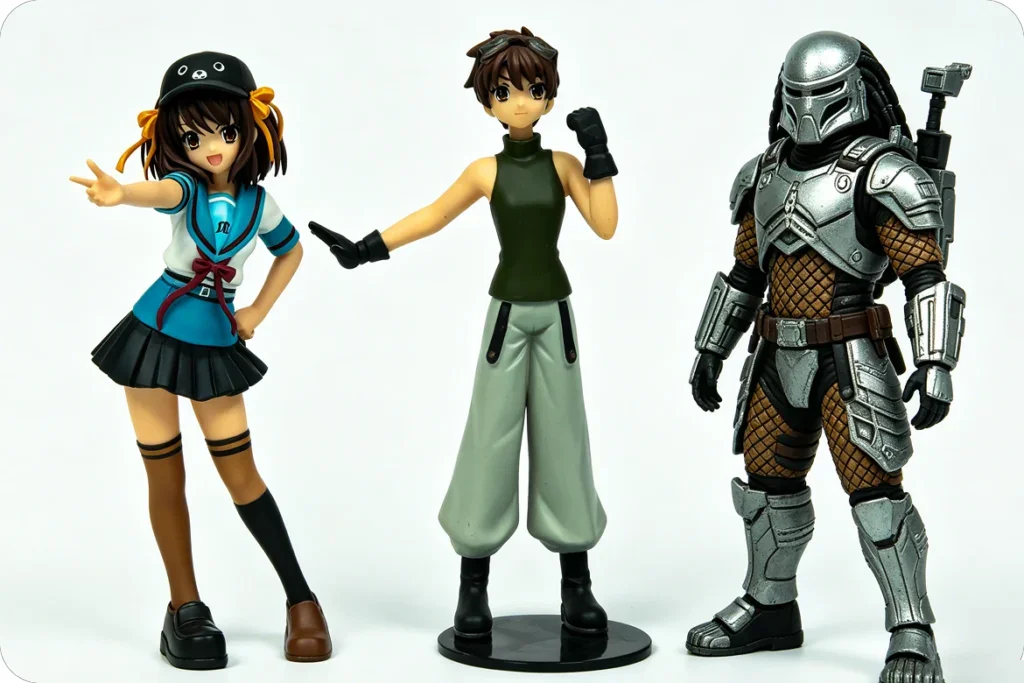
Production volume dictates material selection because automated PVC injection molding requires high-cost steel tooling designed for output runs exceeding 2,000 units, whereas manual resin casting utilizes low-cost silicone molds optimized for limited high-margin collector editions under 1,000 pieces.
1.1 High-Volume Injection Scaling for Commercial Retail
For global brands managing massive intellectual property commercialization campaigns, anime blind box series, or large retail distribution chains, PVC is the standard material choice. The manufacturing workflow is highly automated, utilizing multi-cavity steel molds mounted in automated injection molding presses. Once the parameters for melt temperature, injection speed, and cooling cycles are calibrated, a single press can output thousands of identical, low-unit-cost parts every 24 hours.
This massive output rate makes PVC the ideal choice for retail markets where maintaining stock availability across hundreds of physical storefronts is critical. For example, large-scale anime figure releases and commercial capsule toy lines rely entirely on PVC’s fast cycle times. The initial setup requires strict engineering calibration, but once active, the marginal cost per piece remains extremely low, maximizing profitability over high-volume distribution networks.
1.2 Low-Volume Open-Molding for Premium Exclusives
Resin collectibles target an entirely different market dynamic, focusing on exclusivity, boutique scarcity, and high-margin retail pricing tiers. Resin replication relies on Room Temperature Vulcanization silicone molds into which liquid polyurethane resin is manually poured and cured, often inside pressurized vacuum chambers to eliminate structural air pocket defects.
Because this process is highly manual and silicone molds naturally degrade and tear after only 25 to 30 casting cycles, it cannot scale to meet mass retail demands. Instead, it serves as the premier choice for limited artist editions, high-end statues, or convention exclusives restricted to runs of 100 to 1,000 total units. This low-volume threshold allows independent designers and crowd-funded Kickstarter campaigns to launch products without incurring heavy industrial manufacturing overhead.
Table 1: Production Metrics and Sourcing Inflection Points
| Manufacturing Metric | PVC Injection Molding | Polyurethane Resin Casting |
| Typical Minimum Order Quantity | 2,000 to 5,000 units | 100 to 500 units |
| Production Speed per Mold | 30 to 60 seconds per cycle | 20 to 40 minutes per curing cycle |
| Tooling Lifespan | 500,000+ cycles (Hardened Steel) | 25 to 30 cycles (Flexible Silicone) |
| Primary Target Market | Mass retail, blind boxes, pop culture chains | High-end galleries, Kickstarter rewards, boutique hobby shops |
2. How Do PVC and Resin Differ in Surface Detail and Paint Quality?
Collectible valuations rely heavily on fine visual fidelity. Subpar micro-textures or sloppy paint application ruins character likenesses, leading to poor customer reviews, high return rates, and loss of future distribution channels.
Resin figurines provide superior surface detail because the low-viscosity liquid polymer flows effortlessly into complex textures without pressure, capturing deep geometric undercuts. PVC delivers excellent commercial detail but requires intensive multi-part mold segmentation to avoid parting-line distortions.
2.1 Micro-Textures and Geometric Undercut Replication
Liquid polyurethane resin possesses an incredibly low viscosity before chemical curing, allowing it to easily flow into the finest details of a silicone mold, including skin pores, fabric weaves, and complex hair strands. Because the silicone mold is flexible, it can be stretched and peeled away from deep undercuts without breaking the cured part. This allows designers to engineer dynamic, fluid poses with overlapping geometric structures.
In comparison, traditional rigid alternatives like collectible porcelain figurines are highly restricted by firing shrinkage and material thickness limitations. While porcelain offers a premium weight, resin allows for vastly superior mechanical and organic detailing. Molten PVC, being a highly viscous thermoplastic injected into solid steel mold halves, requires precise draft angles. Any deep undercut will catch on the steel during mold separation, leading to surface scoring or part distortion unless complex, multi-part segmentation is implemented by the toolmaker.
2.2 Advanced Painting Techniques and Adhesion Formulations
Aesthetic quality is heavily dependent on paint application. Resin components provide a slightly micro-porous surface texture that forms an exceptional mechanical bond with professional lacquer and acrylic paints. This allows paint technicians to execute intricate hand-painted detailing, subtle airbrush gradients, directional shadow washes, and metallic finishes that remain vivid over time without flaking or peeling.
PVC components require a specialized surface pre-treatment to strip away mold-release oils, followed by the application of dedicated primers to ensure proper adhesion. For high-speed mass assembly lines, collectible figurine manufacturers must build custom, tight-fitting spray masks and precision pad-printing plates. While PVC handles clean, flat color blocks and sharp graphic tampo prints exceptionally well, replicating the soft, multi-layered depth of a high-end resin statue requires advanced industrial masking setups and tight quality control on the assembly line.
3. What are the Structural Durability and Shipping Risks for Each Material?
Global supply chains place immense mechanical stress on finished goods during transit. Ignoring material fragility profiles results in catastrophic fracture rates, negative product ratings, and expensive international freight insurance claims.
PVC figurines deliver exceptional structural durability due to their elastomeric flexibility, resisting impact damage during drops. Resin figurines are highly rigid and brittle, necessitating dense, custom-molded EVA foam packaging to prevent structural fracturing during international shipping.
3.1 Impact Resistance and Material Deflection Under Load
PVC can be formulated with varying levels of plasticizers to adjust its physical hardness, typically ranging from Shore 70A to 50D. This engineered flexibility allows thin, delicate elements—such as trailing capes, extended weapons, or long hair strands—to deflect and bend under impact force rather than snapping. If a PVC blind box figure falls from a retail shelf, its elastomeric structure absorbs the kinetic energy and deforms elastically before returning to its original shape.
Polyurethane resin cures into a highly cross-linked thermoset plastic polymer that exhibits high tensile strength but very low impact elongation. It is completely rigid, heavy, and brittle. Under drop-test conditions, a resin component cannot bend; it shatters into sharp fragments when subjected to sudden impact forces. This physical limitation presents a massive challenge for intricate action-oriented figures with elongated limbs or thin structural joints.
3.2 Packaging Engineering and Volumetric Shipping Economics
The structural brittleness of resin heavily impacts post-production logistics and total landing costs for US and European buyers. Resin figurines require expensive, custom-molded Expanded Polyethylene or Ethyl Vinyl Acetate foam linings inside heavy-duty corrugated master cartons. This highly protective packaging significantly increases the volumetric weight of each shipment, inflating international air and sea freight rates.
PVC figurines can be safely secured in compact, lightweight vacuum-formed PET blister trays enclosed in standard folding paper boxes. This significantly reduces packaging volume and weight, allowing logistics managers to maximize container loading density and cut shipping costs per unit by up to 40% compared to resin cargo.
4. How Do Tooling Lifecycles and Initial Capital Expenses Impact ROI?
Upfront project capitalization dictates overall financial viability. Procurement managers must evaluate the total lifecycle cost of production tooling assets to avoid unexpected tool wear expenses during recurring product manufacturing runs.
PVC manufacturing requires high initial capital investment for hardened steel injection tooling that lasts over 500,000 cycles with consistent accuracy. Resin requires minimal upfront capital for flexible silicone molds, which must be fully replaced every 25 to 30 castings.
4.1 Amortization of Steel Tooling vs Silicone Molds
The choice between PVC and resin comes down to a classic upfront versus recurring financial trade-off. Developing a custom PVC figurine requires a substantial initial capital investment in multi-part, precision-machined NAK80 or S136 stainless steel injection molds, typically ranging from $15,000 to $40,000 per figure depending on part segmentation.
If a brand intends to produce 50,000 units, a $30,000 tooling investment amortizes down to just $0.60 per unit, making the long-term per-piece production cost extremely competitive. For a limited run of 500 units, however, steel tooling is financially impossible. Resin avoids this high entry barrier because a master silicone mold can be cast for just a few hundred dollars, allowing brands to launch new designs with minimal upfront capital.
4.2 Mechanical Tooling Maintenance and Dimensional Drift
Steel molds maintain precise dimensional tolerances of ±0.05mm across their entire 500,000-cycle operational lifespan without degradation. This ensures that the first part injected fits exactly like the final part produced months later, eliminating downstream assembly issues.
Silicone molds absorb chemical compounds from the exothermic reaction of curing polyurethane resin with every single pour. By the 25th cycle, the silicone loses its elasticity, begins to warp, and exhibits micro-tears along the parting lines. This introduces dimensional drift, flash defects, and a progressive loss of fine detail, forcing operators to constantly scrap old molds and cast new ones from the original master sculpture to preserve quality.
5. Why are Pop Culture Brands Adopting a Hybrid Mixed-Material Approach?
Modern pop culture consumers demand exceptional quality at affordable prices. Relying on a single polymer often forces structural or cost compromises that limit the ultimate retail value of a newly launched designer collection.
Pop culture brands utilize a hybrid approach by combining a mass-produced PVC body with a cast resin head or intricate weapons. This mixed-material strategy maximizes fine aesthetic details while optimizing unit economics and lowering structural transit damage.
5.1 Multi-Polymer Integration in Modern Designer Toys
To capture market share in competitive pop-culture markets, leading designer toy brands frequently employ a hybrid manufacturing methodology. By engineering a figurine with a mixed-material composition, brands can utilize the strengths of each polymer. For example, the core torso and thick legs are injection-molded in high-volume PVC to establish a durable foundation and reduce weight.
Thin, extended elements like outstretched wings or delicate hands are overmolded in flexible PVC or ABS to eliminate transit breakage risks. At the same time, the highly detailed head sculpt or intricate base accessories are manually cast in premium polyurethane resin to capture sharp expressions and complex textures. This clever allocation of materials allows brands to achieve a high-end collectible aesthetic while remaining within mass-market retail pricing tiers.
5.2 Shrinkage Matching and Tolerance Challenges in Assembly
While a hybrid approach yields an exceptional end product, it significantly increases supply chain complexity during the engineering phase. Thermoplastics like PVC experience volumetric shrinkage of 0.4% to 0.7% during injection cooling, whereas thermoset polyurethane resins undergo a chemical curing shrinkage of approximately 0.2%.
If the factory’s engineering team fails to accurately calculate these disparate contraction values when designing the master tooling patterns, the interlocking peg joints will not fit together during final assembly. This requires a highly experienced manufacturer capable of managing precise tolerances across both injection molding and resin casting workflows under a unified production plan.
6. How Do Professional OEM Manufacturers Optimize Collectible Production?
In reality, moving from a digital sculpture to a retail-ready product requires deep manufacturing expertise. Partnering with a generic factory leads to severe aesthetic inaccuracies, delayed production milestones, and compliance test failures.
An experienced OEM manufacturer like Chilbo optimizes production by handling everything from initial DFM part segmentation to premium assembly and surface painting. This integrated, one-stop process ensures total design fidelity, international material safety compliance, and robust IP protection.
6.1 Design for Manufacturing and Dynamic Part Segmentation
Partnering with a specialized manufacturer like Chilbo Industrial Co., Ltd. ensures that your digital 3D models are optimized for mass production before any tooling steel is cut. Our in-house engineering team conducts exhaustive Design for Manufacturability reviews to partition a single character model into 15 to 30 individual interlocking segments.
This advanced segmentation hides unsightly mold parting lines beneath natural anatomy structures or clothing folds, optimizes polymer melt flow through the mold gates, and ensures uniform wall thickness to eliminate cosmetic sink marks. By handling both digital engineering and physical tooling fabrication under one roof, we eliminate communication errors and accelerate product development cycles.
6.2 Quality Control, Materials Compliance, and IP Protection
For global brands managing licensed properties, intellectual property security and strict safety compliance are paramount. Chilbo operates under strict lean manufacturing principles and comprehensive quality management systems. Every batch of incoming virgin polymer undergoes XRF chemical scanning to ensure it is completely non-toxic and compliant with EN71, ASTM F963, and CPSIA frameworks.
Our facility enforces strict non-disclosure protocols and secure mold protection systems to completely safeguard your proprietary character designs. From initial prototype development to final automated retail packaging assembly, we provide a reliable, export-oriented supply chain solution tailored for the US and European markets.
7. Conclusion
Sourcing custom collectibles in 2026 requires moving beyond simple commodity sourcing and prioritizing structural versatility, strict material safety, and precise manufacturing tolerances. For B2B procurement managers and product designers, the choice between PVC and resin is a strategic decision that impacts upfront capital, scaling speed, and brand reputation. Balancing high-volume injection molding with the tight requirements of designer art toys is a precise science.
At Chilbo Industrial Co., Ltd., our engineering and production teams bridge the gap between artistic concepts and scalable manufacturing. We combine advanced injection molding expertise with a deep understanding of international compliance to ensure your products are safe and highly durable. From optimizing draft angles and wall thickness during the DFM phase to ensuring consistent color matching, precise hand-painting, and customized protective packaging, our integrated OEM/ODM solutions eliminate supply chain bottlenecks and accelerate your time-to-market.
Related guides: Compare timelines in our custom toy manufacturing timeline, review the custom designer toy cost breakdown, or explore our designer figurine manufacturing capabilities.
Are you ready to scale your collectible product line without compromising on quality? Stop navigating fragmented supply chains. Contact our engineering team today to request a comprehensive DFM analysis on your latest CAD files, discuss custom mold development quotes, or request physical material samples. Let us help you engineer and manufacture premium collectibles that dominate the global market.
Frequently Asked Questions (FAQs)
Q1: What is the typical tooling cost difference between a PVC injection mold and a resin silicone mold?
A: A professional, multi-cavity hardened steel injection mold for a PVC figurine typically requires an upfront investment between $15,000 and $40,000, depending on the number of part segments and design complexity. In contrast, an open silicone mold for resin casting costs between $200 and $500, making it highly cost-effective for initial low-volume testing.
Q2: How many units can be produced from a single PVC steel mold versus a resin silicone mold?
A: A high-quality steel injection mold constructed from premium tool steels like S136 can easily endure over 500,000 cycles without losing dimensional tolerance. A flexible silicone mold used for polyurethane resin casting naturally degrades due to chemical exposure and exothermic heat, requiring replacement after 25 to 30 casting cycles.
Q3: Why do resin figurines break more easily than PVC figurines during international shipping?
A: Polyurethane resin cures into a thermoset plastic with a rigid, tightly cross-linked molecular matrix that exhibits very low impact elongation, making it brittle under sudden shocks. PVC contains specialized plasticizers that lower its hardness to an elastomeric Shore range, allowing thin components to flex and absorb kinetic energy rather than snapping.
Q4: Can Chilbo execute complex painting techniques like gradient airbrushing and drop shadows on mass-produced PVC figures?
A: Yes. Our advanced secondary processing facility features professional spray-mask molding capabilities and automated pad printing systems. We specialize in high-fidelity collectible finishes, including multi-layered gradient airbrushing, precise shadow washes, metallic coating textures, and fine eye-tampo prints, maintaining strict batch-to-batch consistency.
Q5: How does a mixed-material strategy protect thin, extended parts on a collector-grade statue?
A: By utilizing a hybrid assembly, engineers can cast the heavy, highly detailed main torso and base in premium resin to maintain a high-end feel and sharp textures. Thin, vulnerable elements like swords, antennas, or outstretched fingers are injection-molded in flexible PVC or ABS, eliminating transit fractures.
Q6: What safety testing and material certifications can Chilbo provide for importing toys into the US and EU?
A: Our factory implements a strict Incoming Quality Control protocol using in-house XRF chemical analyzers to verify that all raw resins are non-toxic, lead-free, and BPA-free. We fully support production requirements for EN71 (Europe), ASTM F963 (US), CPSIA, and RoHS compliance, providing complete traceability and testing documentation for seamless customs clearance.