Sourcing low-tolerance educational components introduces structural failures and compliance liabilities. Ignoring these risks leads to expensive product recalls and severe brand damage. High-quality educational parts require strict dimensional precision, certified non-toxic polymers, and robust mold maintenance to ensure long-term product safety and repeatable multi-scenario learning.
Imagine a classroom full of children building a complex mechanical gear set. If even one gear is warped by a fraction of a millimeter, the entire assembly binds, the lesson fails, and the school district marks that toy brand as unreliable. For B2B procurement managers, the true cost of an OEM partner is measured not just in the initial piece price, but in the long-term reliability of the shipped parts. Balancing high-volume injection molding with the tight requirements of educational products is a precise science. Let us break down exactly how elite manufacturers achieve this balance.
Table of Contents
- Why Do Injection Molding Tolerances Dictate the Success of STEM Construction Kits?
- Which Global Safety Certifications are Mandatory for Educational Plastic Components?
- How Do Material Formulations Impact the Durability of Montessori Learning Tools?
- What Architectural Protections are Vital for Educational Electronic Tool Housings?
- How Does a Reliable Tooling Lifecycle Plan Prevent Batch Inconsistency?
- Why is Flexible Manufacturing Essential for Modern Educational Product Brands?
- Conclusion
1. Why Do Injection Molding Tolerances Dictate the Success of STEM Construction Kits?
Achieving flawless mechanical assembly in STEM kits relies heavily on physical consistency. When a manufacturer fails to maintain tight dimensional parameters, the instructional efficacy of the tool falls apart instantly during use.
High-quality educational tool parts require an injection molding tolerance of ±0.05mm or tighter. This precise standard prevents loose connections or overly tight fits in interlocking mechanisms, preserving the tool’s educational value and shielding brands from high product return rates.
1.1 The Mechanics of Friction-Fit Connectors
In structural interlocking beams and modular gear systems used in engineering learning sets, the mechanical engagement between parts must remain uniform across millions of production units. Children lack the grip strength to force together parts warped by uneven mold cooling, yet a loose assembly causes an entire structure to collapse during a classroom demonstration. The theoretical basis of this requirement lies in interference fit engineering: the male plug must be precisely larger than the female receptacle by a calculated micron range to guarantee a secure, repeatable hold without causing stress whitening or micro-fractures in the plastic resin.
When designing these parts, product designers face a critical trade-off between tight tolerances and tooling longevity. Achieving a consistent ±0.05mm tolerance means the custom teaching tool parts manufacturer must employ premium tooling techniques, such as CNC wire cutting and mirror spark EDM machines, during mold fabrication to eliminate micro-imperfections before production starts. To validate this on the factory floor, operators perform regular checks using 3D coordinate measuring machines (CMM) and automated pin gauges. This ensures that a high-volume run of structural components maintains its mechanical performance across different production batches.
1.2 Minimizing Polymeric Warpage Through DFM
Varying wall thicknesses across a single molded part lead to differential volumetric shrinkage as the thermoplastic cools. This creates internal stresses, resulting in sink marks and geometric warpage that destroy part alignment. Product designers can prevent these defects by implementing a comprehensive Design for Manufacturing (DFM) review protocol prior to cutting steel.
A critical DFM strategy involves maintaining uniform wall thickness throughout the component and utilizing structural ribbing to provide rigidity where needed. For example, in a heavy-duty classroom sorting tray or a plastic geometry grid, replacing a thick solid section with a thin-walled ribbed structure reduces material consumption, shortens cooling times, and completely eliminates the risk of volumetric warpage. During high-volume injection molding, engineers must continuously monitor parameters such as melt temperature, injection speed, and packing pressure. By establishing a rigid scientific molding process, the factory ensures that the molten polymer fills the cavities evenly, stabilizing the part’s physical dimensions.
Table 1: Polymer Shrinkage Rates and Tolerance Capabilities
| Material Type | Volumetric Shrinkage Rate | Target Tolerance Capability | Core Educational Application |
| ABS (Acrylonitrile Butadiene Styrene) | 0.4% – 0.7% | ±0.05mm | Structural gears, interlocking bricks, building kit frames |
| PP (Polypropylene) | 1.0% – 2.5% | ±0.12mm | Living hinges, storage trays, large hollow structural blocks |
| TPR (Thermoplastic Rubber) | 1.5% – 3.0% | ±0.15mm | Overmolded soft grips, flexible sensory integration connectors |
2. Which Global Safety Certifications are Mandatory for Educational Plastic Components?
Compliance is the single most critical threshold for entering Western educational markets. Overlooking regulatory certifications risks total asset forfeiture, customs border rejections, and permanent legal damage to your brand.
Educational tool parts must pass EN71, ASTM F963, CPSIA, and RoHS compliance testing. These strict regulatory frameworks verify that plastic components are mechanically durable, chemically non-toxic, and entirely free from heavy metal or phthalate contamination.
2.1 Chemical Testing and Material Traceability
Chemical compliance is a foundational requirement for childhood learning aids, such as colorful counting links for preschoolers or toddler sorting blocks, which frequently come into contact with a child’s skin and mouth. High-quality educational tool parts must be certified completely BPA-free, lead-free, and devoid of regulated phthalate plasticizers. International standards, such as Europe’s EN71 Part 3 and the United States’ CPSIA, dictate strict parts-per-million (ppm) thresholds for heavy metals like cadmium, lead, arsenic, and mercury.
To guarantee this level of safety, a reliable educational tool parts manufacturer enforces a strict Incoming Quality Control (IQC) protocol. This includes testing raw resin batches using X-ray Fluorescence (XRF) spectrometers before the plastic ever enters the injection molding machine hopper. Furthermore, factories must maintain a clean supply chain with clear material lot tracking, ensuring that every batch of virgin polymer can be traced directly back to its original chemical manufacturer. This meticulous documentation protects the brand during third-party regulatory audits and provides peace of mind to institutional school buyers.
2.2 Mechanical Integrity and Physical Abuse Testing
Brittle plastics can break into sharp shards or small fragments that pose choking hazards during rough classroom play. Therefore, the physical design of the parts must withstand severe structural abuse. To ensure maximum physical safety, finished components undergo automated post-production stress testing.
The workflow begins with raw material verification via chemical analysis, moves through precision molding under scientific parameters, proceeds to inline torque and pull validation, and concludes with a physical drop array. For example, high-impact learning frames and snap-together geometry tools are subjected to a rigorous testing regimen: first, a drop test where the component falls from a height of 1.5 meters at multiple angles onto a concrete surface to ensure it does not shatter; next, a torque test applying a twisting force up to 0.45 Nm to small attached components; and finally, a tension test applying a pulling force up to 90 N to verify the mechanical hold of overmolded pieces. By integrating these destruction tests into the standard quality control workflow, an OEM factory ensures that every part shipped can handle the demanding environment of a commercial daycare or training center.
3. How Do Material Formulations Impact the Durability of Montessori Learning Tools?
Tactical classroom tools experience relentless physical handling and chemical sanitization over years of service. Choosing incorrect or low-grade polymer resins leads to rapid surface degradation and part failure.
Montessori learning tool parts achieve long-term durability by utilizing premium, high-impact virgin resins like ABS and Polypropylene. These precise polymer formulations prevent surface splintering, resist degradation from chemical sanitizers, and maintain color uniformity across years of high-frequency classroom use.
3.1 Balancing Haptic Feedback with Polymer Stability
Montessori education and early childhood learning heavily emphasize sensory exploration, requiring materials that provide distinct haptic feedback. Geometric sorting shapes, counting components, and sensory training tools must feel smooth, balanced, and solid. They must be completely free of sharp parting lines, injection gates, or flash. Achieving this high-quality finish requires the custom teaching tool parts manufacturer to employ advanced surface treatments, such as vapor polishing or high-precision textured chemical etching, directly on the mold cavities.
For components that require both structural stiffness and a soft tactile grip, co-injection overmolding is an ideal solution. For instance, in a preschool math counting tool or a science tool grip, a soft Thermoplastic Rubber (TPR) layer is chemically bonded onto a rigid Polypropylene (PP) core during the molding process. This dual-material design provides an excellent tactile experience while preventing the peeling and separation common in low-tier glued assemblies.
3.2 Long-Term Chemical and Wear Resistance
Unlike consumer toys used occasionally at home, educational tool parts in commercial schools undergo frequent sanitization with aggressive chemical disinfectants. Subpar plastics degrade rapidly under these conditions, leading to environmental stress cracking, yellowing, or a sticky surface residue.
Using high-molecular-weight virgin polymers ensures that components remain chemically inert when exposed to isopropyl alcohol, bleach solutions, or commercial dishwashers. This chemical resilience preserves precise dimensions and vibrant color codes, ensuring that sorting tools and math modules remain functionally accurate across thousands of lesson cycles.
4. What Structural Protections Shield Educational Electronics?
Infusing microelectronics into early learning tools introduces a unique set of structural vulnerabilities. Without specialized housing protection, sensitive printed circuit boards break down instantly under standard daily usage.
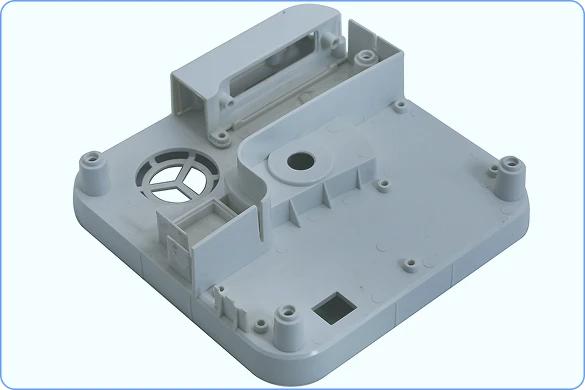
Electronic educational tool housings must feature internal structural ribbing, optimized nominal wall thicknesses of 2.0mm to 2.5mm, and tool-secured battery compartments. These integrated mechanical features absorb drop-shocks and satisfy international electronic safety regulations.
4.1 Engineering Drop-Shock Absorption for PCBs
Electronic educational tools, like interactive talking pens or electronic flashcard reader shells, require a protective outer chassis engineered to survive high-impact drops. Instead of simply increasing the overall wall thickness—which increases material costs and creates cosmetic sink marks—experienced engineers design localized internal rib structures. These ribs support the internal Printed Circuit Board (PCB) assembly and distribute impact energy throughout the entire chassis.
A correct ribbed design places thin structural intersecting walls along the interior of the casing shell. This contrasts with an incorrect thick-walled design, which uses an excessive amount of raw material and creates significant surface warpage due to long cooling times. The structural ribs should be designed to 40% to 60% of the nominal outer wall thickness to prevent cosmetic defects on the exterior surface. Guide bosses and mounting posts must also feature generous draft angles (typically 1.5 to 2 degrees) to allow smooth ejection from the mold core without distorting the internal fastening points.
4.2 Battery Compartment Integrity and Threaded Inserts
International safety standards mandate that children must not access internal batteries without a tool. Educational electronic housings must incorporate a separate, isolated battery compartment secured by a machine screw threading into a brass threaded insert.
Relying on self-tapping screws driven directly into raw plastic leads to stripped threads after a few battery changes, compromising safety. Ultrasonic welding or hot-staking brass inserts into the molded housing ensures long-term mechanical reliability, protecting sensitive components and keeping the product compliant with global consumer safety rules.
5. How Does an Advanced Tooling Plan Prevent Batch Drift?
Microscopic tool wear over extended manufacturing runs slowly causes severe dimensional shifts in molded parts. Without a proactive mold management program, your product’s quality will steadily decline over time.
Advanced OEM manufacturers implement predictive tool maintenance schedules every 50,000 cycles and use automated process control systems. This structured oversight eliminates parting-line flash, maintains micro-tolerances, and ensures absolute batch-to-batch consistency for millions of units.
5.1 Hardened Steel Selection and PM Schedules
The quality of an injection-molded component depends directly on the integrity of its steel tooling. For intricate, high-volume products like multi-cavity interlocking blocks, the mold experiences immense clamping force, high injection pressures, and thermal cycling. Over time, these stresses cause microscopic wear on parting lines, core pins, and gate locations, which can lead to flashing and dimensional drift.
To prevent these defects, a comprehensive tool management program tracks tool wear and schedules preventive maintenance at set milestones. At 0 cycles, the mold is built to an ultra-precise baseline verified by CMM. At 50,000 cycles, stage 1 servicing cleans vents and checks ejector retraction. At 250,000 cycles, stage 2 servicing replaces worn pins and polishes cavities. Beyond 1,000,000 cycles, a major overhaul verifies final tolerance limits. Utilizing premium tool steels, such as H13 or S136 stainless steel hardened to 48-52 HRC, provides excellent resistance to abrasive resins and flame-retardant additives. This ensures the tooling maintains sharp parting lines and flawless cavity alignment throughout its operational life.
5.2 Scientific Molding and Closed-Loop Control
Relying on manual machine adjustments introduces human error and creates batch variance. Modern educational tool parts OEM manufacturing facilities use automated, closed-loop process control systems. By placing cavity pressure and temperature sensors inside the mold, injection molding machines can adjust parameters in real time.
If melt temperature, injection speed, or holding pressure shifts outside established control limits, the system flags the defective parts automatically. This scientific molding approach guarantees that parts produced months apart retain identical dimensions, density, and mechanical properties, delivering true batch-to-batch consistency.
6. Why is Flexible Manufacturing Critical for Modern Brands?
Launching specialized product variations across multiple global regions requires an agile, highly responsive production model. Rigid supply chains with massive volume requirements delay critical market entry and drain capital.
Flexible manufacturing enables brands to combine low-volume trial orders for initial regional validation with seamless scaling into high-volume production. Consolidating engineering, prototyping, and assembly with a single vendor drastically compresses product launch timelines.
6.1 Low-Volume Validation and Multi-SKU Strategy
In the educational products sector, brands often launch specialized tool sets tailored to specific language requirements, curriculum standards, or regional age brackets. Committing to a 50,000-unit production run for an untested market carries high financial risk. Agile OEM suppliers solve this by offering flexible manufacturing options, allowing low-volume trial orders (e.g., 1,000 to 3,000 units) to validate market demand before scaling up.
This flexibility requires quick-change mold bases and modular cavity inserts. By swapping out an internal cavity insert while keeping the primary mold base in the machine, the factory can alter a component’s molded-in text or branding elements in under an hour. This optimization reduces tooling costs and streamlines the management of multi-SKU product lines.
6.2 Supply Chain Consolidation and Turnkey Delivery
Managing multiple vendors for design, tooling, molding, pad printing, and final retail packaging introduces communication delays, quality finger-pointing, and increased transit costs. Consolidating production with a single, expert manufacturing partner streamlines the entire workflow. A traditional fragmented supply chain routes a project through separate design, tooling, molding, and assembly vendors, yielding high risks of delay.
In contrast, an integrated workflow unifies engineering, an in-house mold shop, precision injection molding, and turnkey assembly under one roof. This consolidated approach ensures that DFM insights are built directly into the initial tooling design. In-house secondary operations—such as custom color matching, multi-color pad printing, ultrasonic welding, and final automated retail packaging—allow brands to transition smoothly from a digital CAD file to a retail-ready product. This unified process reduces lead times, protects IP, and ensures consistent quality control.
7. Conclusion
Sourcing high-quality educational tool parts in 2026 requires moving beyond simple commodity sourcing and prioritizing structural versatility, strict material safety, and precise manufacturing tolerances. For B2B procurement managers and product designers, the difference between a successful global product launch and a costly recall lies entirely in the capabilities of your manufacturing partner.
At Chilbo (Dongguan) Industrial Co., Ltd., our engineering and production teams bridge the gap between educational concepts and scalable manufacturing. We combine advanced injection molding expertise with a deep understanding of international compliance (ASTM F963, EN71, CPSIA) to ensure your products are safe and highly durable. From optimizing draft angles and wall thickness during the DFM phase to ensuring consistent ABS color matching, precise assembly, and customized packaging, our integrated OEM/ODM solutions eliminate supply chain bottlenecks and accelerate your time-to-market.
Are you ready to scale your educational product line without compromising on quality? Stop navigating fragmented supply chains. Contact our engineering team today to request a comprehensive DFM analysis on your latest CAD files, discuss custom mold development quotes, or request physical material samples. Let us help you engineer and manufacture educational tool parts that dominate the global market.
Frequently Asked Questions (FAQs)
Q1: What is the standard dimensional tolerance Chilbo maintains for precision educational tool parts? A: For high-quality educational tool parts OEM manufacturing, we regularly maintain a strict tolerance of ±0.05mm using premium engineering resins like ABS and Polycarbonate. For less critical parts or flexible elastomeric materials like TPR, tolerances are held between ±0.12mm and ±0.15mm based on standard SPI guidelines.
Q2: How does your factory verify that incoming plastic resins are non-toxic and lead-free? A: We implement a strict Incoming Quality Control (IQC) protocol. Every incoming batch of raw resin must arrive with material safety data sheets (MSDS) and traceability certs. We then run independent verification tests using in-house X-ray Fluorescence (XRF) spectrometers to confirm the material is free from heavy metals, phthalates, and BPA before production begins.
Q3: Can we use a single mold base to produce multi-language variations of an educational tool? A: Yes. We design custom tooling using modular cavity inserts. This allows us to exchange specific parts of the mold—such as plates with raised text or symbols—in under an hour, without needing to fabricate an entirely new mold base. This approach significantly reduces upfront tooling expenses for multi-SKU lines.
Q4: What mechanical stress tests do you perform to ensure toys won’t break into dangerous small pieces? A: We perform a standard array of mechanical tests, including a 1.5-meter multi-angle drop test onto a concrete slab, torque testing up to 0.45 Nm, and structural tension/pull testing up to 90 N. These tests ensure the components will not crack, splinter, or break into hazardous sharp edges or small parts during rough use.
Q5: How do you protect sensitive microelectronics inside plastic learning aid housings? A: During our DFM review, we design optimized internal rib structures that cradle the PCB and distribute impact energy evenly across the housing. We also integrate brass threaded inserts for battery compartment doors, ensuring they remain secure and compliant with international safety rules after repeated battery changes.
Q6: What certifications does Chilbo hold for exporting educational products to the US and European markets? A: Our manufacturing processes and facilities are aligned with top international standards, and we support production requirements for EN71, ASTM F963, CPSIA, and RoHS compliance. We routinely provide full documentation and material test reports to ensure smooth customs clearance and retail acceptance.